Around the Horn and Home Again for That Is the Sailors Way
| Joshua Upham Slocum | |
|---|---|
 From The Century Magazine, Sept. 1899 | |
| Built-in | (1844-02-xx)February 20, 1844 Mount Hanley, Nova Scotia |
| Died | Nov fourteen, 1909(1909-11-14) (anile 65) Lost at sea |
| Nationality | Canadian (by nascence, Nova Scotia – 1869) naturalized Usa citizen |
| Known for | Outset solo circumnavigation of the world (1895–1898) |
| Spouse(s) | Virginia Walker (thousand. 1871 - 1884),Henrietta Slocum (thousand. 1886-1909) |
| Children | Victor Slocum Benjamin Slocum Jessie Slocum James Slocum |
| Parent(southward) | John Slocombe Sarah Southern |
| Relatives | Joshua Slocum |
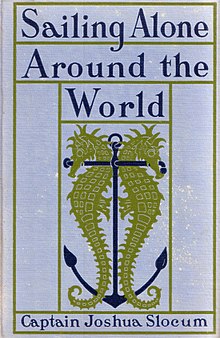
Joshua Slocum (Feb 20, 1844[1] – on or shortly after November xiv, 1909) was the get-go person to sail single-handedly around the world. He was a Nova Scotian-built-in, naturalised American seaman and adventurer, and a noted writer. In 1900 he wrote a book about his journey, Sailing Alone Around the World, which became an international all-time-seller. He disappeared in Nov 1909 while aboard his boat, the Spray.
Nova Scotian childhood [edit]
Joshua Slocum was born on February xx, 1844[1] in Mountain Hanley, Annapolis County, Nova Scotia (officially recorded equally Wilmot Station),[1] a community on the N Mountain inside sight of the Bay of Fundy. The 5th of xi children of John Slocombe[1] [two] and Sarah Jane Slocombe née Southern,[1] Joshua descended, on his begetter's side, from a Quaker known as "John the Exile" who left the United States shortly later on 1780 because of his opposition to the American War for Independence.[one] [3] Office of the Loyalist migration to Nova Scotia, the Slocombes were granted 500 acres (ii.0 kmtwo) of farmland in Nova Scotia's Annapolis County.

Joshua Slocum was built-in in the family unit's farm house in Mount Hanley and learned to read and write at the nearby Mountain Hanley Schoolhouse. His earliest ventures on the water were fabricated on coastal schooners operating out of the small ports such equally Port George and Cottage Cove almost Mount Hanley along the Bay of Fundy.
When Joshua was viii years old, the Slocombe family (Joshua changed the spelling of his last proper name later on in his life)[iv] moved from Mount Hanley to Bramble Island in Digby County, at the mouth of the Bay of Fundy. Slocum's maternal grandfather was the keeper of the lighthouse at Southwest Indicate there. His male parent, a stern human and strict disciplinarian, took upwardly making leather boots for the local fishermen, and Joshua helped in the shop. However, the boy establish the scent of table salt air much more alluring than the smell of shoe leather. He yearned for a life of adventure at sea, away from his demanding male parent and his increasingly chaotic life at habitation among and then many brothers and sisters.
He made several attempts to run away from home, finally succeeding, at age fourteen, past hiring on equally a motel boy and cook on a angling schooner, but he soon returned home. In 1860, later the birth of the eleventh Slocombe child and the subsequent decease of his kindly mother, Joshua, then xvi, left dwelling house for good. He and a friend signed on at Halifax equally ordinary seamen on a merchant send bound for Dublin, Ireland.
Early on life at body of water [edit]
From Dublin, he crossed to Liverpool to become an ordinary seaman on the British merchant ship Tangier (also recorded equally Tanjore), spring for China. During two years every bit a seaman he rounded Cape Horn twice, landed at Batavia (now Djakarta) in the Dutch East Indies, and visited the Maluku Islands, Manila, Hong Kong, Saigon, Singapore, and San Francisco. While at ocean, he studied for the Board of Trade examination, and, at the age of eighteen, he received his document as a fully qualified 2nd Mate. Slocum quickly rose through the ranks to become a Chief Mate on British ships transporting coal and grain between the British Isles and San Francisco.
In 1865, he settled in San Francisco, became an American citizen, and, after a menstruation spent salmon fishing and fur trading in the Oregon Territory of the northwest, he returned to the sea to airplane pilot a schooner in the coastal trade between San Francisco and Seattle. His commencement blue-water command, in 1869, was the barque Washington, which he took across the Pacific, from San Francisco to Australia, and home via Alaska.
He sailed for thirteen years out of the port of San Francisco, transporting mixed cargo to China, Australia, the Spice Islands, and Japan. Between 1869 and 1889 he was the master of viii vessels, the first four of which (the Washington, the Constitution, the Benjamin Aymar and the Amethyst) he commanded in the employ of others. Later, in that location would be four others that he himself endemic, in whole or in office.
Family unit at sea [edit]

Virginia Albertina Walker
Before long before Christmas 1870, Slocum and the Washington put in at Sydney. There, in about a month's time, he met, courted, and married a immature woman named Virginia Albertina Walker. Their spousal relationship took place on Jan 31, 1871. Miss Walker, quite coincidentally, was an American whose New York family had migrated west to California at the time of the 1849 gold rush and somewhen continued on, by ship, to settle in Australia. She sailed with Slocum, and, over the next thirteen years, the couple had seven children, all born at sea or foreign ports. Iv children, sons Victor, Benjamin Aymar, and James Garfield, and daughter Jessie, survived to machismo.
In Alaska, the Washington was wrecked when she dragged her anchor during a gale, ran ashore, and broke up. Slocum, however, at considerable risk to himself, managed to salve his wife, the coiffure, and much of the cargo, bringing all back to port safely in the send'due south open boats. The owners of the shipping company that had employed Slocum were so impressed by this feat of ingenuity and leadership, they gave him the command of the Constitution which he sailed to Hawaii and the west coast of Mexico.
His next command was the Benjamin Aymar, a merchant vessel in the South Seas trade. Even so, the owner, strapped for cash, sold the vessel out from under Slocum, and he and Virginia constitute themselves stranded in the Philippines without a ship.
The Pato [edit]
While in the Philippines, in 1874, under a committee from a British builder, Slocum organized native workers to build a 150-ton steamer in the shipyard at Subic Bay. In partial payment for the work, he was given the 90-ton schooner, Pato (Spanish for "Duck"), the first ship he could call his ain.
Ownership of the Pato afforded Slocum the kind of freedom and autonomy he had never previously experienced. Hiring a crew, he contracted to deliver a cargo to Vancouver in British Columbia. Thereafter, he used the Pato every bit a general freight carrier along the west coast of North America and in voyages dorsum and forth between San Francisco and Hawaii. During this menstruation, Slocum also fulfilled a long-held ambition to get a author, and became a temporary correspondent for the San Francisco Bee.
The Slocums sold the Pato in Honolulu in the spring of 1878. Returning to San Francisco, they purchased the Amethyst. He worked this ship until June 23, 1881.[v]
The Slocums next bought a third share in the Northern Light two. This large clipper was 233 anxiety in length, 44 anxiety axle, 28 anxiety in the hold. It was capable of carrying 2000 tons on 3 decks. Although Joshua Slocum called this send "my best command", it was a control plagued with mutinies and mechanical problems. Nether troubling legal circumstances (caused by his alleged treatment of the principal mutineer) he sold his share in the Northern Light ii in 1883.[6]
The Aquidneck [edit]
The Slocum family continued on their next send, the 326-ton Aquidneck. In 1884, Slocum's wife Virginia became ill aboard the Aquidneck in Buenos Aires and died. After sailing to Massachusetts, Slocum left his three youngest children, Benjamin Aymar, Jessie, and Garfield in the care of his sisters; his oldest son Victor continued as his start mate.[vii]
In 1886, at historic period 42, Slocum married his 24-year-onetime cousin, Henrietta "Hettie" Elliott. The Slocum family, with the exception of Jessie and Benjamin Aymar, once more took to the body of water aboard the Aquidneck, bound for Montevideo, Uruguay. Slocum's 2d wife would discover life at sea much less appealing than his commencement. A few days into Henrietta'southward start voyage, the Aquidneck sailed through a hurricane. By the end of this first year, the crew had contracted cholera, and they were quarantined for half dozen months.[8] Later, Slocum was forced to defend his ship from pirates, i of whom he shot and killed; following which he was tried and acquitted of murder. Next, the Aquidneck was infected with smallpox, leading to the death of three of the crew. Disinfecting of the ship was performed at considerable cost. Before long afterward, near the finish of 1887, the Aquidneck was wrecked in southern Brazil.[viii] [nine]
The Liberdade [edit]
Later on being stranded in Brazil with his wife and sons Garfield and Victor, he started building a gunkhole that could sail them home. He used local materials, salvaged materials from the Aquidneck, and worked with local workers. The boat was launched on May 13, 1888, the very day slavery was abolished in Brazil, and therefore the transport was given the name Liberdade, the Portuguese word for freedom. It was an unusual 35-foot (11 m) junk-rigged pattern which he described every bit "half Greatcoat Ann dory and half Japanese sampan".[9] He and his family began their voyage back to the U.s., his son Victor (15) being the mate.
After fifty-5 days at body of water and 5510 miles,[10] the Slocums reached Greatcoat Roman, South Carolina[11] and continued inland to Washington D.C. for the winter and finally reaching Boston via New York in 1889.[9] This was the terminal time Henrietta sailed with the family. In 1890, Slocum published his accounts of these adventures in Voyage of the Liberdade.[nine] [12]
Voyage of the Destroyer [edit]
In the northern winter of 1893/94, Slocum undertook what he described as, at that time, beingness "the hardest voyage that I have e'er made, without any exception at all."[13] It involved delivering the steam-powered torpedo boat Destroyer from the eastward declension of the U.s.a. to Brazil.
Destroyer was a send 130 anxiety in length, conceived by the Swedish-American inventor and mechanical engineer John Ericsson, and intended for the defence force of harbours and coastal waters. Equipped in the early on 1880s with sloping armour plate and a bow-mounted submarine gun, information technology was an evolution of the Monitor warship type of the American Ceremonious War. Destroyer was intended to burn down an early class of torpedo at an opposing ship from a range of 300 feet, and was a "vessel of war partially armored to attack bows-on at short range."[xiv]
Despite the loss of the Aquidneck and the privations of his family unit'south voyage in the self-built Liberdade, Slocum retained a fondness for Brazil. During 1893, Brazil was faced with a political crunch in Rio Grande do Sul and an effort at civil war that was intensified by the revolt of the land's navy in September.[15]
Slocum agreed to a request by the Brazilian government to deliver the Destroyer to Pernambuco, Brazil, with fiscal and vindictive motives. Equally Slocum describes, his contract with the commander of government forces at Pernambuco was, "to get against the insubordinate fleet, and sink them all, if we could find them – large and little – for a handsome sum of gold …" Slocum also saw the possibility of getting even with the "arch rebel" Admiral Melo (of whom he writes equally "Mello"): "Confidentially: I was burning to get a rake at Mello and his Aquideban. He it was, who in that ship expelled my bawl, the Aquidneck, from Ilha Grande some years ago, under the cowardly pretext that we might accept sickness on board. But that story has been told. I was burning to let him know and palpably experience that this time I had in dynamite instead of hay".
Towed by the Santuit, Slocum and a small crew aboard the Destroyer left Sandy Hook, New Bailiwick of jersey, on 7 December 1893. The following day the ship was already taking on water: "A calamity has overtaken us. The ship's top seams are opening and one of the new sponsons, the starboard 1, is already waterlogged." Despite all hands pumping and bailing, by midnight the seas were extinguishing the fires in the boilers which were kept alight only by throwing on rounds of pork fat and tables and chairs from the vessel.
With a tempest standing to accident on the 9th, the crew was able to lower the level of h2o in the concord and plug some of the holes and leaks. The bailing out of h2o using a large improvised sail bag continued from the 9th to the 13th and succeeded in maintaining the level of water in the hold below three feet. On the 13th they were again hit past a storm and cross seas and had to bond all nighttime. On the 14th, heavy seas disabled the rudder. By the afternoon of fifteen Dec, the Destroyer was to the southwest of Puerto Rico, heading for Martinique, and all the same weathering storms.
By this time, with the fires in the boilers extinguished, all hands were bailing for their lives: "The master hull of the Destroyer is already a foot under water, and going on downward". The crew had no other option than to keep bailing and endeavor to keep the ship adrift, as the vessel "could not be insured for the voyage; nor would any company insure a life on lath". By the morn of the 16th the storm had abated, assuasive the Destroyer to anchor to the south of Puerto Rico.
Although the ship's all-time steam pump had been put out of activeness on 19 December, more favourable seas immune the crew to reach Martinique, where repairs were made before again setting sail on five January 1894. On 18 January the Destroyer arrived at Fernando de Noronha, an island some 175 miles from the declension of Brazil, before finally reaching Recife, Pernambuco, on the 20th. Slocum wrote: "My voyage home from Brazil in the canoe Liberdade, with my family for coiffure and companions, some years ago, although a much longer voyage was not of the same ho-hum nature."
At Pernambuco, the Destroyer joined up with the Brazilian navy and the coiffure was over again engaged in repairs as the long tow in heavy seaways had severed rivets at the bow, resulting in leaks. Moisture powder led to a failed examination firing of the submarine gun and the ship was grounded to remove the projectile. But the strain of the swell led to a farther leak. Following further repairs the Destroyer fabricated for Bahia with replenishments of powder for the Brazilian fleet, arriving on 13 February. Once there, yet, Admiral Gonçalves of the Brazilian navy seized the ship. At the Arsenal at Bahia, an apparently incompetent culling coiffure grounded the Destroyer on a rock in the basin. The vessel was holed and subsequently abased.
[edit]

In Fairhaven, Massachusetts, from 1891 to 1892, Slocum rebuilt the 36 ft 9 in (11.20 grand) gaff rigged sloop oyster gunkhole named Spray. On June 21, 1892, he launched the painstakingly rebuilt vessel.
On April 24, 1895, he set canvas from Boston, Massachusetts. In his famous volume, Sailing Alone Effectually the World,[xvi] now considered a classic of travel literature, he described his deviation in the following way:
I had resolved on a voyage around the earth, and as the wind on the morn of Apr 24, 1895 was off-white, at noon I weighed ballast, set up sheet, and filled away from Boston, where the Spray had been moored snugly all winter. The twelve o'clock whistles were blowing only as the sloop shot ahead under total sail. A brusk board was fabricated upward the harbor on the port tack, then coming about she stood to seaward, with her boom well off to port, and swung past the ferries with lively heels. A lensman on the outer pier of Eastward Boston got a motion picture of her as she swept by, her flag at the peak throwing her folds clear. A thrilling pulse beat out high in me. My step was calorie-free on deck in the well-baked air. I felt there could be no turning back, and that I was engaging in an risk the meaning of which I thoroughly understood.
After an extended visit to his boyhood home at Brier Island and visiting quondam haunts on the declension of Nova Scotia, Slocum departed Northward America at Sambro Island Lighthouse near Halifax, Nova Scotia on July 3, 1895.
Slocum intended to canvas eastward around the earth, using the Suez Canal, but when he got near Gibraltar he realized that sailing through the southern Mediterranean would be too dangerous for a lone sailor because of the piracy still going on there at the time. And then he decided to sail due west, in the southern hemisphere. He headed to Brazil, and so to the Straits of Magellan. At that point he was unable to start across the Pacific for twoscore days because of a storm. Eventually he made his mode to Australia, sailed northward along the e coast, crossed the Indian Ocean, rounded the Cape of Expert Hope, and then headed dorsum to Due north America.
Slocum navigated without a chronometer, instead relying on the traditional method of dead reckoning for longitude, which required but a inexpensive tin clock for approximate time, and noon-lord's day sights for latitude. On i long passage in the Pacific, He also famously shot a lunar altitude observation, decades after these observations had ceased to be ordinarily employed, which allowed him to check his longitude independently. Nevertheless, Slocum's primary method for finding longitude was however dead reckoning; he recorded just one lunar observation during the entire circumnavigation.
Slocum normally sailed the Spray without touching the helm. Due to the length of the canvass programme relative to the hull, and the long keel, the Spray was capable of cocky-steering (unlike faster modern craft), and he balanced it stably on any class relative to the wind past adjusting or reefing the sails and by lashing the helm fast. He sailed 2,000 miles (iii,200 km) w across the Indian Ocean without once touching the helm.[sixteen]
More three years later, on June 27, 1898, he returned to Newport, Rhode Isle, having circumnavigated the world and sailing a distance of more than 46,000 miles (74,000 km). Slocum'south render went nigh unnoticed. The Castilian–American War, which had begun 2 months earlier, dominated the headlines. Afterward the cease of major hostilities, many American newspapers published manufactures describing Slocum'south take chances.
Sailing Lonely Around the Earth [edit]

Spray being hauled up the Erie Culvert to the Pan-American Exposition in Buffalo 1901.
In 1899 he published his business relationship of the voyage in Sailing Lone Effectually the Earth, start serialized in The Century Magazine and then in several book-length editions. Reviewers received the slightly anachronistic age-of-canvas run a risk story enthusiastically. Arthur Ransome went and so far as to declare, "Boys who practice non like this book ought to be drowned at in one case."[17] In his review, Sir Edwin Arnold wrote, "I practise non hesitate to call it the most boggling book ever published."
Slocum's book bargain was an integral role of his journey: his publisher had provided Slocum with an extensive on-board library, and Slocum wrote several letters to his editor from distant points effectually the world. His Sailing Alone won him widespread fame in the English-speaking world. He was ane of 8 invited speakers at a dinner in award of Mark Twain in December 1900. Slocum hauled the Spray up the Erie Culvert to Buffalo, New York for the Pan-American Exposition in the summer of 1901, and he was well compensated for participating in the off-white.
After life [edit]
In 1901, Slocum's book revenues and income from public lectures provided him enough financial security to buy a small subcontract in Due west Tisbury, on the island of Martha's Vineyard, in Massachusetts. After a year and a half, he found he could not adjust to a settled life and he sailed the Spray from port to port in the northeastern Us during the summer and in the Westward Indies during the wintertime, lecturing and selling books wherever he could. Slocum spent niggling time with his married woman on Martha'south Vineyard and preferred life aboard the Spray, ordinarily wintering in the Caribbean.
Slocum and the Spray visited Sagamore Loma, the estate of US President Theodore Roosevelt on the n shore of Long Island, New York. Roosevelt and his family unit were interested in the tales of Slocum's solo circumnavigation. The President's young son, Archie, along with a guardian, spent the adjacent few days sailing with Slocum upward to Newport aboard the Spray, which, by then, was a decrepit, weather-worn vessel. Slocum again met with President Roosevelt in May 1907, this fourth dimension at the White House in Washington. Supposedly, Roosevelt said to him, "Captain, our adventures have been a little different." Slocum answered, "That is truthful, Mr. President, but I see you got here commencement."[18]
Past 1909, Slocum's funds were running depression; book revenues had tailed off. He prepared to sell his farm on Martha'south Vineyard and began to make plans for a new risk in South America. He had hopes of some other book deal.[18]
Disappearance [edit]
On Nov fourteen, 1909,[19] Slocum gear up canvass in the Spray from Vineyard Haven, Massachusetts for the Westward Indies on one of his usual winter voyages. He had as well expressed interest in starting his adjacent run a risk, exploring the Orinoco, Rio Negro and Amazon Rivers.[16] Slocum was never heard from again. In July 1910, his wife informed the newspapers that she believed he was lost at sea.
Despite being an experienced mariner, Slocum never learned to swim[20] and considered learning to swim to exist useless.
In 1924, Joshua Slocum was declared legally dead.[20]
Legacy [edit]
Joshua Slocum'south achievements have been well publicised and honoured. The name Spray has become a choice for cruising yachts ever since the publication of Slocum'due south account of his circumnavigation. Over the years, many versions of Spray take been congenital from the plans in Slocum's book, more than or less reconstructing the sloop with various degrees of success.
Similarly, the French long-distance sailor Bernard Moitessier christened his 39-pes (12 m) ketch-rigged boat Joshua in honour of Slocum. It was this boat that Moitessier sailed from Tahiti to French republic, and he also sailed Joshua in the 1968 Sunday Times Gilt Globe Race around the world, making skilful fourth dimension, merely to abandon the race virtually the end and sail on to the Polynesian Islands.
Ferries named in Slocum's honour (Joshua Slocum and Spray) served the two Digby Neck runs in Nova Scotia between 1973 and 2004.[21] The Joshua Slocum was featured in the film version of Dolores Claiborne.[22]
An underwater glider—an democratic underwater vehicle (AUV), designed by the Scripps Institute of Oceanography, was named subsequently Slocum's ship Spray. It became the first AUV to cantankerous the Gulf Stream, while operated by the Forest Hole Oceanographic Institution.[23] Some other AUV has been named subsequently Slocum himself: the Slocum Electric Glider, designed by Douglas Webb of Webb Enquiry (since 2008, Teledyne Webb Enquiry).
In 2009, a Slocum glider, modified past Rutgers University, crossed the Atlantic in 221 days.[24] The RU27 traveled from Tuckerton, New Bailiwick of jersey, to Baiona, Pontevedra, Kingdom of spain — the port where Christopher Columbus landed on his return from his first voyage to the New World. Like Slocum himself, the Slocum glider is capable of traveling over thousands of kilometers. These gliders continue to be used by various inquiry institutions, including Texas A&M University'due south Department of Oceanography and Geochemical and Environmental Enquiry Grouping (GERG), to explore the Gulf of United mexican states and other bodies of water.[25]
A monument to Slocum exists on Brier Isle, Nova Scotia, not far from his family's boot store. He is commemorated in museum exhibits at the New Bedford Whaling Museum in Massachusetts, the Maritime Museum of the Atlantic in Halifax, Nova Scotia, and the Mount Hanley Schoolhouse Museum near his birthplace. Several biographies nigh Slocum are published.
The Slocum River in Dartmouth, Massachusetts was named for him, as was a newly discovered plant in Mauritius while he was there: "Returning to the Spray by way of the great flower conservatory virtually Moka, the proprietor, having only that morning discovered a new and hardy constitute, to my bang-up honor named it 'Slocum'".[26] Slocum himself discovered an island past accident, and named it Alan Erric Island.[27]
Slocum was inducted into the National Sailing Hall of Fame in 2011.[28]
See besides [edit]
- Harry Pidgeon, first to solo circumnavigate via the Panama Culvert
- List of people who disappeared at sea
References [edit]
- ^ a b c d e f Slocum, Charles Elihu (1882). A Short History of the Slocums, Slocumbs and Slocombs of America. Vol. 1. Syracuse, NY: Charles Elihu Slocum. pp. 542, 551.
- ^ Geoffrey Wolff, The Hard Way Around: The Passages of Joshua Slocum, p eight: spelling of family proper noun given as "Slocombe".
- ^ Geoffrey Wolff, The Hard Style Around: The Passages of Joshua Slocum, p 11
- ^ Geoffrey Wolff, The Hard Way Around: The Passages of Joshua Slocum)
- ^ Geoffrey Wolff, The Difficult Manner Around: The Passages of Joshua Slocum, pgs. 70–75
- ^ Geoffrey Wolff, The Hard Way Effectually: The Passages of Joshua Slocum, pgs. 76–111
- ^ Berthold pg nineteen
- ^ a b Berthold pg xx
- ^ a b c d Slocum (1890), Voyage of the Liberdade
- ^ Victor Slocum (1950), p. 193
- ^ Cape Roman 33°three′48″N 79°twenty′43″W / 33.06333°N 79.34528°Westward / 33.06333; -79.34528 (Cape Roman)
- ^ Berthold pg xxi–xxii
- ^ Slocum, Joshua (1894). "Voyage of the Destroyer from New York to Brazil". Eldritch Press. Retrieved September 13, 2016.
- ^ Jaques, William H. (1885). "Ericsson's Destroyer and Submarine Gun". Archive.org. GP Putnam. Retrieved September 13, 2016.
- ^ Bello, José Maria (1966). A Modern History of Brazil: 1889-1964. Stanford Academy Press. ISBN9780804702386 . Retrieved September thirteen, 2016.
- ^ a b c Slocum (1899), Sailing Alone Effectually the World
- ^ Arthur Ransome on Sailing Lonely Around the World
- ^ a b Teller, Walter Magnes (1971). Joshua Slocum . New Brunswick, North.J: Rutgers Academy Press. ISBN0-8135-0700-6.
- ^ E.One thousand.Consulting & Computer Services. "Joshua Slocum and His Travels". world wide web.joshuaslocumsocietyintl.org . Retrieved September six, 2013.
- ^ a b Spencer, Ann (1998). Alone At Ocean: The Adventures of Joshua Slocum. Doubleday Canada. ISBN0385257201.
- ^ "valleyweb Resource and Information". valleyweb.com.
- ^ Smith, Ivan. "Joshua Slocum Memorial".
- ^ "Spray AUV". UC San Diego.
- ^ "Flight Beyond the Atlantic - RU27 - RU17". marine.rutgers.edu.
- ^ "Gliders give key ocean information from gulf". Texas A&Yard University.
- ^ Slocum, J (1899), Chapter XVII
- ^ Slocum, J (1899), affiliate 10
- ^ "Joshua Slocum 2011 Inductee". Nshof.org. Retrieved April 12, 2020.
Bibliography [edit]
- Berthold, Dennis A., ed. (2005). "Introduction". Sailing Lonely Effectually the World. New York: Barnes & Noble. thirteen–xxxvi. ISBN978-1-59308-303-eight.
- Slocum, Joshua (2005) [1899]. Sailing Alone Around the Earth. New York: Barnes & Noble. ISBN978-1-59308-303-8.
- Slocum, Joshua (1890) [1890]. Voyage of the Liberdade. Boston: Robinson & Stephenson.
- Slocum, Victor (2001) [1950]. Capt. Joshua Slocum: The Life and Voyages of America'due south Best Known Sailor. Dobbs Ferry, NY: Sheridan House. ISBN0-924486-52-X.
- Grayson, Stan (2017). A Man for All Oceans — Captain Joshua Slocum and the Offset Solo Voyage Around the World. Tilbury Business firm Publishers and the New Bedford Whaling Museum. p. 401. ISBN978-0-88448-548-3.
External links [edit]
- Joshua Slocum – New World Columbus – documentary on YouTube
- Joshua Slocum Society
- Biography at the Dictionary of Canadian Biography Online
- Works by Joshua Slocum at Project Gutenberg
- Works by or well-nigh Joshua Slocum at Internet Archive
- Works by Joshua Slocum at LibriVox (public domain audiobooks)

- HTML e-text of Sailing Solitary Effectually the Globe with illustrations
- Ebooks of Sailing Lone Around the World, Voyage of the Liberdade, and Voyage of the Destroyer, optimized for printing, plus selected Slocum bibliography
- Joshua Slocum memorial, Westport, Nova Scotia
- Joshua Slocum, un gran marino (Spanish)
- YouTube video operation of "Helm Slocum Sailed Around the Globe" past Howard Bowe
- Sailing Alone Effectually the Earth at BookBrainz
- Sailing Lone Around the World at MusicBrainz
Source: https://en.wikipedia.org/wiki/Joshua_Slocum
0 Response to "Around the Horn and Home Again for That Is the Sailors Way"
Post a Comment