Exoskeletons From Japan Now Available in Us to Help People Learn How to Walk Again
Tokyo (CNN)Kristen Sorensen was 55 when she became paralyzed from the neck downwards last yr.
"It came out of nowhere," says Sorensen. "I'd been fine and exercising every day, simply information technology just started with tingling in my fingertips then progressed."
Diagnosed in October 2022 with Guillain Barre syndrome, a rare disorder that affects the torso's nervous organization, she never expected to walk once more.
But earlier that year, the Brooks Cybernic Handling Centre in Jacksonville, Florida, became the outset U.s.a. center to apply a unique rehabilitative technology developed in Japan -- the Hybrid Assistive Limb (HAL).
HAL -- essentially a wearable cyborg -- helps those with spinal cord injuries and muscular dystrophy regain their movements and strengthen their nerves and muscles. Known every bit exoskeletons, they're a type of lightweight suit, with joints powered past small electric motors, that serve equally mechanical muscle.
Here'due south what's truly heed-blowing: Patients use their encephalon waves to control them.
When Sorensen heard about the brain moving ridge-controlled exoskeleton, which was developed by Japanese roboticist Yoshiyuki Sankai, she knew she had to give it a endeavor. She was determined to walk at her girl's wedding a few months afterwards in December.
Just information technology's not just those with disabilities or injuries who stand to benefit. Past 2050, in that location will be more than than 2 billion people over age 60, co-ordinate to the Earth Health Organisation (WHO), and exoskeletons could offer a solution to the world's aging population.
In the hereafter, as homo bodies wear downward with age, an exoskeleton -- powered by agile minds -- could help people stay on their feet.
With such huge potential applications bachelor, the global medical exoskeleton market place volition be worth an estimated $ii.8 billion by 2023, co-ordinate to enquiry visitor Markets and Markets.
Users in the driving seat
When Sorensen commencement tried HAL, she could barely motion across flat surfaces.
A trained physiotherapist at the Brooks Middle helped her fit HAL over her waist and trousers, connecting her to sensors that help pick up faint bio-electric signals on the surface of the skin, which communicate a patient's intention to move. Once HAL receives these signals, it helps support the person's movements.

But you can't just put on HAL and expect to be sprinting in seconds. Rehabilitation requires time, determination and the help of a physiotherapist and a torso weight harness that ensures patients are supported and kept upright while they employ HAL on a treadmill. During that preparation, physiotherapists keep a log of each patient's motions and the settings used -- from walk to jog mode. They tin monitor the user'due south movements and adjust the settings accordingly, so their movements come more naturally.
Sorensen says it initially felt like HAL was doing nigh of the work by helping induce her muscles to make pocket-size leg movements that mimic natural walking patterns, merely then she found herself increasingly in the driving seat.
"After the beginning couple times, your brain connects to HAL, and I could meet I was moving my legs myself," she says. "It was just incredible -- my heart was but bursting."
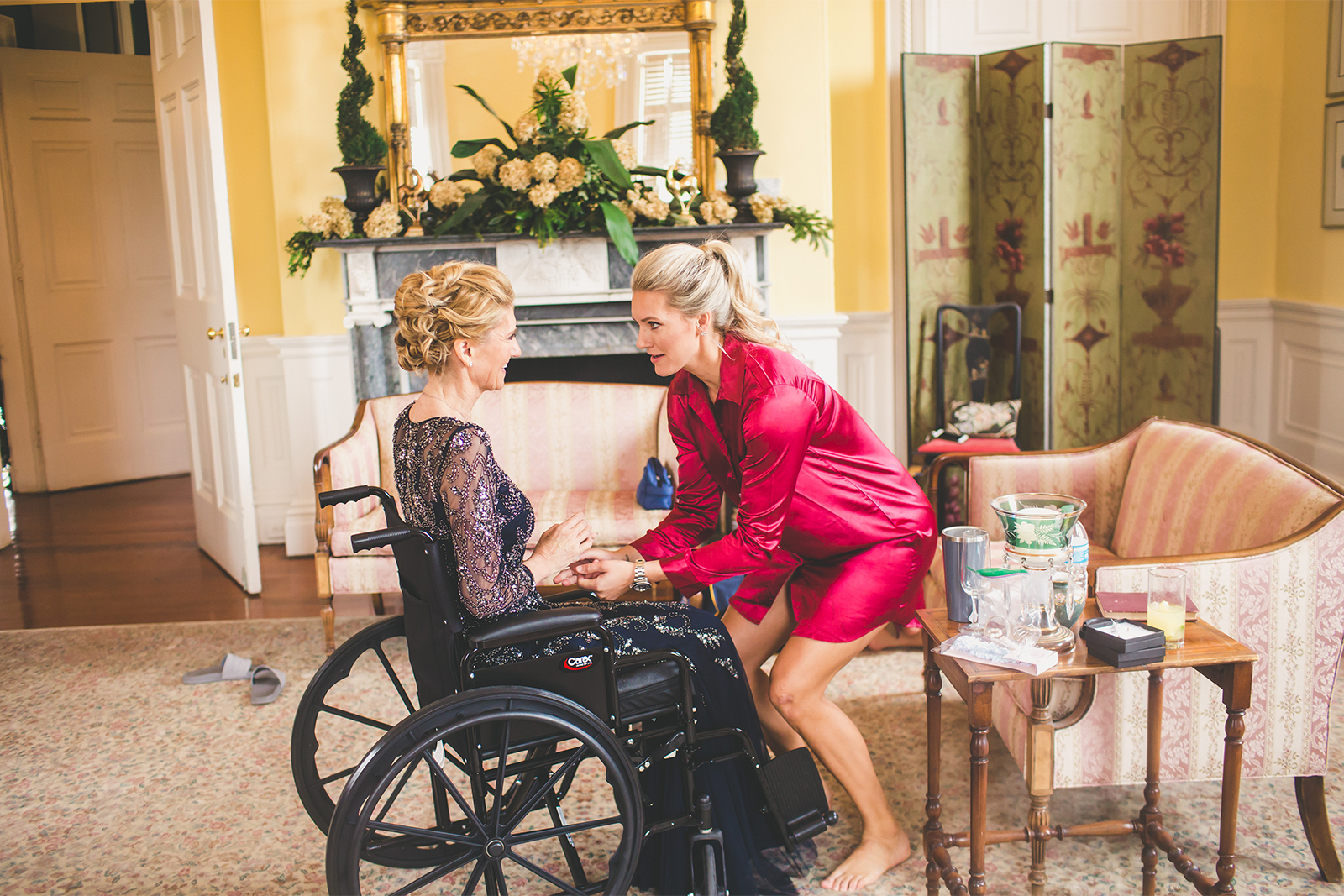
Kristen Sorensen was adamant to walk at her girl'due south wedding.

She overcame her paralysis past training with HAL.
Unremarkably it takes those with less astringent mobility issues than Sorensen between 2 to 10 tries for patients to get used to HAL so that the sensors and the encephalon can first working together, co-ordinate to Sankai. But after well-nigh 40 training sessions, each lasting an hr-and-a-half, Sorensen was dorsum on her anxiety, admitting with the support of a walker. She fabricated information technology to her daughter's wedding ceremony.
Currently, Sankai's exoskeletons are helping patients restore their musculus movements in Nippon, the Philippines and in Deutschland and Poland.
Tech for adept
The brain behind HAL is bespectacled billionaire roboticist Sankai. He heads upward Japanese company Cyberdyne -- founded in 2004 -- where his vision has been to create these "article of clothing cyborgs" designed to "fuse man, machine and information."
And while the name of Sankai's firm might call up the scary Cyberdyne Technologies that created villainous robots in US science-fiction blockbuster "Terminator," the Japanese roboticist wants to create tech non for war, but for peace and rehabilitation.

When Sankai was a 9-twelvemonth-old in the 1960s, he discovered "I, Robot" by science fiction writer Isaac Asimov and became entranced by the positive applications of technology. He decided to pursue engineering at the University of Tsukuba in Japan. In 1998, Sankai fabricated his first HAL prototype, which became the world'southward first, and spent the next decades refining the production into the sleek, lightweight version of today.
Previously robotic-assistance tech centered on military use. Just these days, HAL is part of a moving ridge of research that focuses on using exoskeleton tech to treat ailments or provide support to wearers. For instance, researchers at Harvard unveiled a soft exosuit in 2022 that enhances a patient's strength, much like HAL. And automobile makers like Ford are using exoskeletons on factory floors to reduce worker fatigue. HAL, too, has potential beyond the medical field, with everything from rescue and support and labor intensive manufactory work to entertainment and elderly care.
"The average historic period of workers (in Nippon) is very high, so these technologies can aid them and gradually increase elderly people's physical functions then they tin remain independent," says Sankai.
Just when new technologies are created at that place are few or no social and legal rules to regulate them.
Sankai says these measures must be debated in advance so all parties involved in the industry and use of technologies such every bit exoskeletons maintain control over the evolution direction. Cyberdyne has two ethics committees; one dedicated to promoting research; the other on standing by the idea of peace when creating and developing new devices and technologies.
Next up, Sankai and his squad are collecting information on their treatment method to better ameliorate their existing medical devices. Sankai's aim is to prepare medical devices that will maintain and increase human being health for longer.
For at present, he is happy seeing everyone from seniors to the severely disabled regain independence. It'southward a thought that Sorensen shares.
"When I used HAL, at that place were people who came from all over the country to utilize the equipment," she says. "I would similar this kind of technology to be more than readily bachelor."
Source: https://www.cnn.com/2019/09/18/health/japan-cyberdyne-brain-wave-exoskeleton-wellness-scn-hnk-intl/index.html
0 Response to "Exoskeletons From Japan Now Available in Us to Help People Learn How to Walk Again"
Post a Comment