directions on how to draw a 3d house
A spherical panorama is 1 that captures, not simply 360° around, but all the way up and down also. It captures every direction. I want to show yous how you can hand draw (or sketch, pigment, etc.) these panoramas.
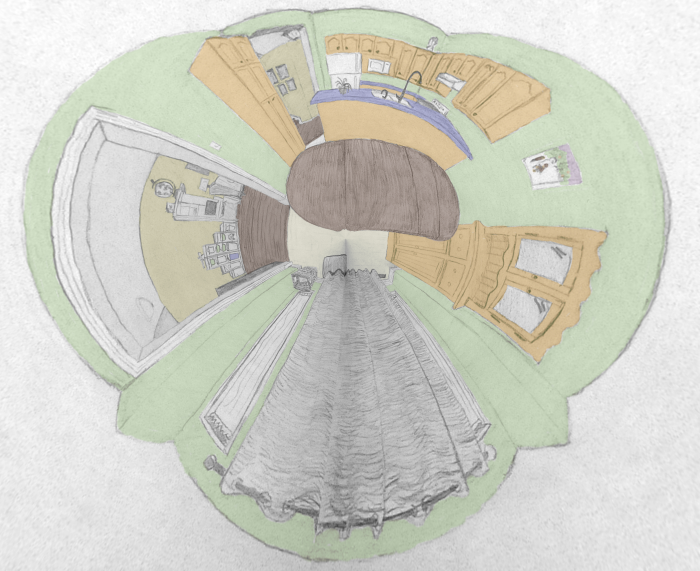
For instance, hither's my kitchen.

And if you lot can depict one that adheres to the equirectangular project, yous tin can upload it to sites like Flickr and Facebook which provide interactive panorama viewers like these ones:
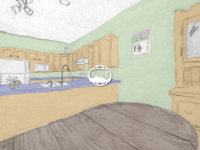
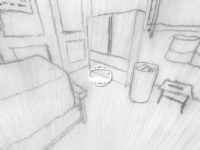
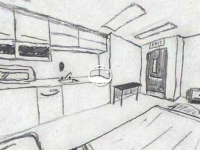
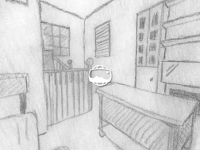
Hand drawn panoramas are an uncommon art form but they aren't new. Artists like Dick Termes, Matthew Lopas, Jackie Lima, Arno Hartman, and Tom Lechner have been cartoon or painting complete or ultra-wide-angle panoramas for some fourth dimension. Matthew Lopas' facebook page features many such paintings, and Tom Lechner's flickr group has more examples.
Fun right? It seems there are every bit many ways to accomplish hand drawn panoramas as at that place are artists doing this. I can prove you how I did mine. Follow along.
Step 0 – Become familiar with equirectangular projections
It is a good thought to become familiar with what an equirectangular projection is before you head out to describe 1. Skip to step 1 if you lot are. If non, hither'southward one at present!

An equirectangular projection maps your surroundings to a rectangle with 360 equally spaced degrees from the left to right and 180 every bit spaced degrees upward and down. Take a look at the equirectangular group on Flickr for more examples. Notice how the the left side wraps around and continues on the right. Also notice how the height and bottom get all stretched out.
Let's do a demonstration. From where you lot are sitting now, notice that an border coming from one corner of a ceiling will be angled upwards. Practise it. Look upward from your screen. And then, scanning along the height of the wall to a betoken right in front of you, that edge will be level. Moving farther, the corner will be at a downwards angle.
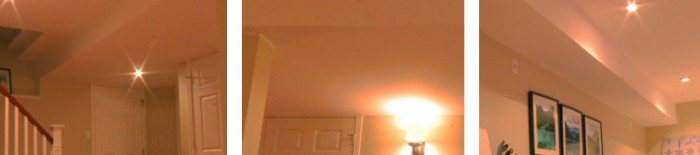
Actually that'south all an equirectangular projection is doing. It's changing the orientation of things to appear as they do when you plow your caput to scan the room.
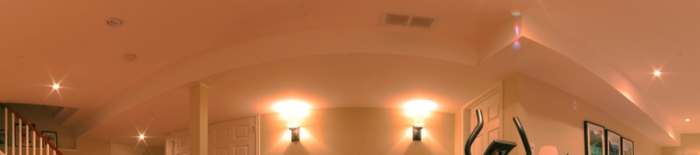
The method beneath helps us describe these curves properly.
Step 1 – Go setup
Pick a location with plenty of rectangular shapes and lines.
Get your drawing materials: pencil, eraser, easel, and paper.
Download and print a version of this equirectangular perspective grid. Legal size newspaper (8.v″×fourteen″) is a great size for this purpose.

I have two ways of superimposing (subimposing?) this grid onto paper. The commencement 1 is straightforward. Use tracing newspaper and tape or pin it down on top of the grid. The 2d is to print the grid onto the back of the paper you're drawing on. And then, when you're drawing, make sure the paper is on a lite surface so that the blackness lines on the back of the newspaper show through.
Step 2 – Locate your surround onto the grid
Marshal yourself with your surroundings. Option a wall or a building to be forward and face up information technology squarely. Now y'all can associate half dozen chief existent-life directions with these locations on your grid:
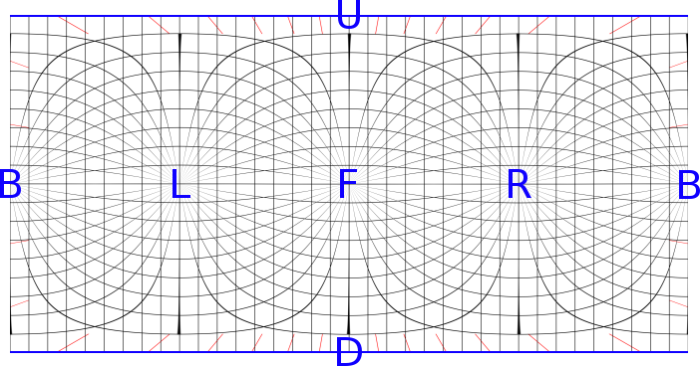
The sets of lines emanating from each of these directions are spaced 10° apart. I prepare of lines go from straight forrad to straight back, one goes from left to right and the third set go upwardly and downwardly.
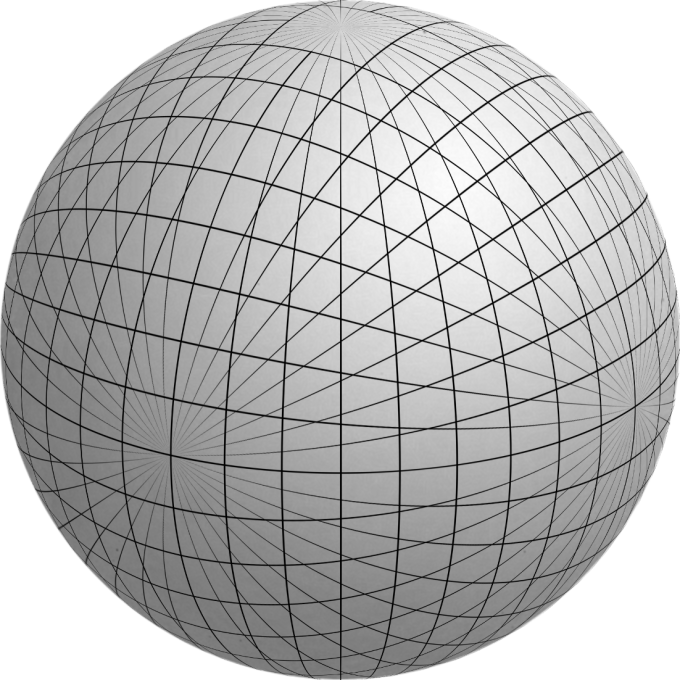
Your job now, is to figure out where each item in your surround belongs on the grid newspaper. You demand to measure 2 angles. The first is the horizontal angle between straight forwards and your object: theazimuth. The 2nd is the vertical bending between your object and the horizon: thealtitude.
Azimuth
 If you're lazy and don't care too much well-nigh accuracy like me, you lot can follow the astronomers' tricks described here to measure out angles from the known points in your scene.
Another method uses the red marks that I placed the edge of the perspective graph paper. With your newspaper level, each crimson tick mark will bespeak the direction from the eye of the paper out towards your environment in 10° increments.
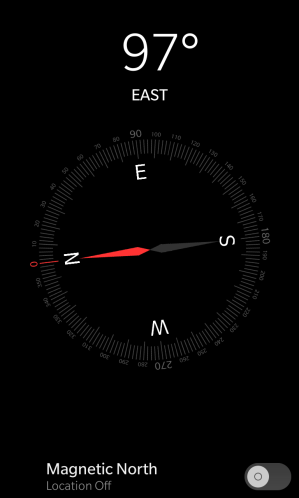
A third style is to use a compass app on your smartphone. Yous'll have to do a little math. For case, if your compass says 97° when facing forward and it says 128° when facing an object and then the object has an azimuth of 128° – 97° = 31°.
Altitude
To measure upwards (or down) from the horizon, imagine the horizon line and then apply those astronomer tricks again.
For a more than mechanical method, what you lot want is a clinometer. Await online for how to make i yourself – y'all tin fifty-fifty purchase them ready made.
And of form your smartphone can do this as well. Many level apps have a clinometer fashion. Merely look forth the long edge of your phone similar a sight.
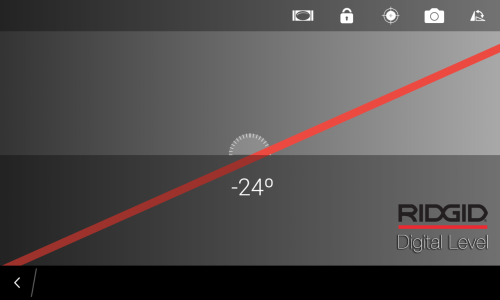
At this point, it's good to mention that it'southward up to you to decide how independent you lot wish to be from technology. If you go also far, you might equally well just trace a picture taken by a spherical camera. On the other side of the spectrum you tin can just forgo the grid and wing the whole thing. What I do, is I proceed the grid newspaper, but I exercise without the smart phone apps.
Locate your betoken on the grid
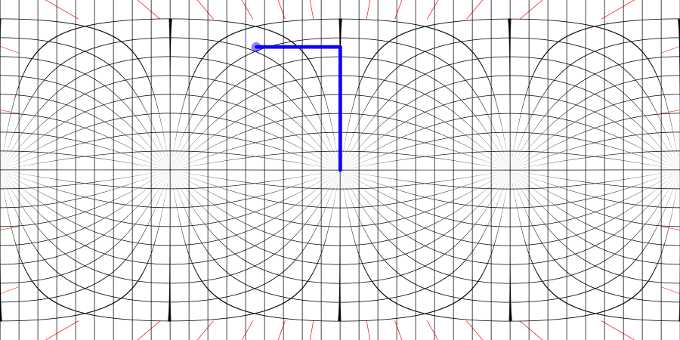
So, at present that you accept the altitude and azimuth of a point in space, you lot can find where it is on your grid. You lot'll desire to locate the altitude first. Hither'south an case. Say your altitude is 65° and your azimuth is -45°. Starting at forward, go 6½ lines up, and then iv½ lines to the left.
Stride 3 – Draw!
Draw the straight lines of your scene in the aforementioned way as a ii-point perspective drawing. That is, if the line in the scene is plumb, draw the line vertically. If the line is frontwards / backwards, follow the direction of the lines that become between the forwards / backwards vanishing points. If your line in the scene goes left to right, follow the lines that go between the left / right vanishing points.
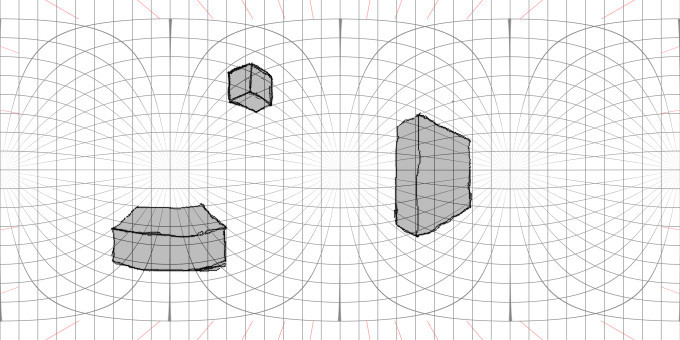
I like to start straight frontwards and build outwards.
You may rely on previous line placements. Say you've drawn one corner of a rectangle, follow the edge along the graph-paper lines to become to the next corner.
Information technology might help to cover imperfections. If lines aren't meeting up where they should exist, look for compromises.
In an equirectangular project, the top and bottom become extremely distorted. So drawing your chair might be difficult. More often then not yet, the space directly in a higher place you (the zenith) and the space below you (the nadir) are rather featureless.
Do more! This method will layout your scene merely for heaven's sake, if you have a favourite medium (pen and ink, paint, digital painting, woodcut printing, watercolor, etc.), and then past all means utilise it.
Step 4 – Browse, upload and share
Mark the corners of the sketch. They'll exist useful when you crop and marshal your scanned motion picture.
If you have grid printed on the dorsum of your paper, scan or photograph your cartoon with a nighttime paper behind it. The filigree will disappear, and only your drawing will stand out. But if y'all used tracing paper, put a white paper backside information technology.
Once you've scanned your motion picture, photo editing software can help you straighten, crop and scale it to friction match the two:ane attribute ratio.
You can share it every bit is. Only to become the immersive view on Flickr, tag your prototype with the tag 'equirectangular'. For Facebook, things are a lot trickier. You have to fix the paradigm's metadata before uploading information technology.
Personally, I like to transform spherical panoramas using interesting mathematical mappings. This gives me a chance to 'compose' the image into something dynamic. Stereographic images usually plow out very nicely.
Source: https://dmswart.com/2016/06/28/drawing-a-panorama/
0 Response to "directions on how to draw a 3d house"
Post a Comment